English
 中文简体

Industry News
A supportive shape alone won't make an Adjustable Lumbar Support Cushion comfortable all day. The way it attaches matters just as much. Hybrid work, home offices, shared desks and flexible seating all change how people use their chairs. A cushion that creeps downward, drifts sideways or falls off when you move is a constant distraction, and you end up fixing it again and again. Elastic straps, buckles, hook-and-loop closures and dual-strap layouts each hold a cushion against the chair back in a different way. Knowing how they work makes it easier to pick a lumbar support that suits your seat and your routine.
What Attachment Methods Keep an Adjustable Lumbar Support Cushion in Place?
The attachment system links the cushion to the chair back. It keeps the cushion where you put it while you sit, recline or shift posture. Designs rely on tension, fastening pressure or several contact points to limit unwanted movement.
An Adjustable Lumbar Support Cushion commonly uses one of these methods:
- Adjustable elastic straps: Wrap around the chair back and give flexible tension.
- Buckle fastening systems: Lock adjustable straps in place and make removal easy.
- Hook-and-loop straps: Use reusable fastening surfaces to secure the cushion.
- Dual or crossed straps: Spread the attachment tension across different areas of the chair back.
Each has its own strengths. The best choice depends on the chair's dimensions, the backrest material, how the cushion is built and how often you change position.
Adjustable Elastic Straps Provide Flexible Attachment
Elastic straps are popular because they stretch to fit many chair back shapes. You can adjust the cushion without needing a rigid mount.
They usually start at the rear of the cushion and loop around the chair back. Once the cushion is in place, the tension holds it against the seat surface.
Key points:
- Flexible adjustment for different backrest sizes
- Easy installation and removal
- Less movement when the strap length is set properly
- Works with many seating setups
Elastic does wear out, though. Repeated stretching loosens it over time. Check the straps now and then, and replace any that look weak or damaged.
Buckle Fasteners Help Keep Straps Secure
A buckle locks two strap sections together. The selected length stays put without depending only on elastic tension.
A typical design has two buckle halves that click together behind the chair. Some also let the strap slide through an adjuster.
Practical benefits:
- A definite locking connection
- Quick fastening and release
- Adjustable strap tension
- Less chance of the strap working loose during ordinary movement, once it is fastened properly
A buckle usually belongs to a wider strap system and isn't a method on its own. How well it performs depends on the strap material, the buckle's build and correct installation.
Hook-and-Loop Straps Allow Convenient Repositioning
Hook-and-loop fasteners, often called Velcro, have two matching surfaces that grip when pressed together.
You can move the fastening area and change how snugly the cushion sits against the chair.
They work well when:
- The chair offers a suitable spot for strap placement
- The cushion gets repositioned often
- Fast installation and removal matter
- Youd rather avoid a rigid buckle
Watch the surface condition. Dust, loose fibers and debris weaken the grip between the two sides. A regular check keeps the attachment dependable.
Dual and Crossed Straps Distribute Attachment Tension
Some Adjustable Lumbar Support Cushion designs use two straps in place of one. They may run parallel or cross behind the chair back.
The extra attachment points share the tension and limit unwanted movement.
Dual straps can help when:
- The chair back is fairly tall
- The cushion needs more positioning support
- One strap can't hold the desired position
- The chair lets both straps be fastened properly
Results depend on where the straps sit and whether the chair suits them. Adding straps doesn't guarantee a firmer hold.
Which Attachment Method Provides Greater Cushion Stability?
Methods differ in how they hold the cushion, how they cope with movement and how well they adapt to chair designs. Comparing them in practical terms shows which one suits your needs.
How Do Elastic Straps Compare With Buckle Fasteners?
Elastic gives flexibility. A buckle gives a lock. Many cushions combine the two to balance easy adjustment with a firm hold.
Picture an elastic strap with an adjustable buckle. It stretches around the chair back, and you control its length.
The difference is simple. Elastic creates tension, and the buckle keeps the setting you chose.
Is Hook-and-Loop Attachment Suitable for Every Chair?
Hook-and-loop makes repositioning easy, but whether it works depends on the chair structure and the way the cushion is designed.
Smooth leather, textured fabric, mesh and padded upholstery each react differently to fasteners. A strap that wraps around the chair back doesn't rely on surface conditions the way an adhesive-style attachment does.
Find out whether the product uses a full wrapping strap or needs direct contact with a specific surface.
Attachment Methods at a Glance
| Attachment Method | Main Advantage | Consideration |
|---|---|---|
| Elastic Straps | Flexible tension and adjustment | Material may stretch |
| Buckle Fasteners | Locking connection | Buckle must be secured correctly |
| Hook-and-Loop | Convenient repositioning | Fastening surfaces need upkeep |
| Dual Straps | Multiple attachment points | Needs a suitable chair structure |
| Crossed Straps | Helps control cushion movement | Correct positioning matters |
When comparing an Adjustable Lumbar Support Cushion, look at the whole attachment system. Judging one part alone can mislead you.
How Does Chair Design Affect Lumbar Cushion Attachment?
A fastening system that suits one chair may not suit another. Backrest thickness, shape, surface material and frame construction all affect how a cushion stays put.
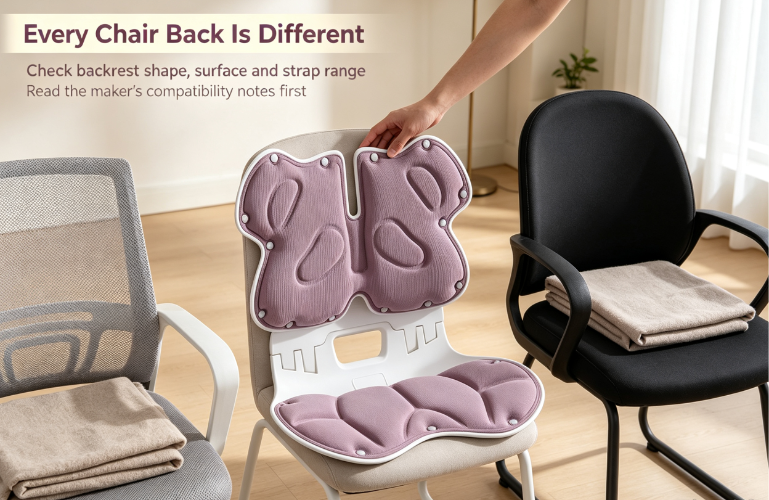
Office Chairs Require Flexible Attachment Options
Office chairs come with mesh backs, upholstered panels, curved frames and adjustable backrests.
Elastic straps cope with varied dimensions, and an adjustable buckle controls the connection around the chair.
Before installing, check:
- Whether the strap can pass around the chair back
- Whether the backrest has exposed structural parts
- Whether the cushion can sit against the intended support area
- Whether the attachment gets in the way of chair adjustments
Pay extra attention on mesh chairs. Their frames and flexible surfaces can change where the strap sits.
Car Seats Need Stable Positioning During Driving
Car seats have angled backrests, side bolsters and adjustable headrests. These affect where the cushion sits and how the straps run.
A good attachment keeps the cushion in place without blocking normal seat movement or vehicle safety equipment.
Drivers should confirm that:
- The straps don't block seat controls
- The cushion doesn't interfere with the seat belt
- The fastening stays secure when the seat reclines
- The cushion doesn't press uncomfortably on the back
Check the cushion again whenever you change the seat position.
Wheelchairs Need Compatible Backrest Fastening
Wheelchair backrests vary in width, height, frame structure and upholstery.
An Adjustable Lumbar Support Cushion should fit the available attachment area and leave the chair's normal operation alone.
Look at:
- Strap length and adjustment range
- Compatibility with the wheelchair frame
- Clearance around moving parts
- Cushion position during transfers and daily activity
For wheelchair users, the design should also make inspection and removal easy when needed.
Gaming and Home Chairs Have Different Attachment Requirements
Gaming chairs often have curved backrests, thick padding and built-in headrests. Home chairs may have wooden frames, upholstered panels or decorative shapes.
These differences decide which fastening system can be fitted properly.
A flexible strap can follow a curved backrest. A dual-strap design may add positioning options where the chair structure allows.
Always read the manufacturer's compatibility guidance before installing.
How Should You Install an Adjustable Lumbar Support Cushion?
Good installation lets the attachment system do its job. Even a well-made strap fails if it is routed wrongly or adjusted without regard to the chair.
Follow these steps.
Step 1: Identify the Suitable Support Position
Hold the cushion against the chair back and set its height to suit how you sit.
It should touch the lower back comfortably and not push your body into an odd posture.
Look at the shape of the backrest before you fasten the straps.
Step 2: Route the Straps Around the Chair Back
Pass the straps around the intended attachment area, following the manufacturer's instructions.
Keep them away from moving joints, adjustment mechanisms and exposed parts that could damage the material.
Step 3: Connect the Buckles or Fastening Surfaces
With buckles, join both halves until they lock.
With hook-and-loop, line up the surfaces and press them firmly together.
Make sure the strap isn't twisted.
Step 4: Adjust the Strap Tension
Tighten or loosen the straps until the cushion sits snugly against the chair.
Too much tension stresses the strap, the buckle or the chair material. Too little lets the cushion move.
Step 5: Check the Cushion Before Sitting
Before regular use, look at the attachment from behind and the cushion from the front.
Confirm that:
- The cushion stays in the intended position
- The straps are connected correctly
- The fastening parts are undamaged
- The chair still reclines and adjusts normally
Repeat the check after moving the cushion or switching chairs.
Why Does an Adjustable Lumbar Support Cushion Keep Slipping?
A cushion that keeps moving may have an attachment problem, an installation mistake or a poor match with the chair.
Find the cause first. Otherwise you'll keep tightening straps without fixing anything.
Loose Straps Allow Unwanted Movement
Straps that are too long or not tight enough let the cushion slide down.
What to do: Check the strap adjustment and shorten the length where the design allows. Position the cushion correctly before tightening.
Smooth or Curved Backrests Can Affect Attachment
Some chair surfaces give little friction. Curved backrests can pull straps toward narrower sections.
What to do: Read the product's chair compatibility notes. See whether the attachment is made to wrap around your backrest shape.
Worn Fasteners Can Reduce Holding Strength
Elastic stretches, buckles get damaged and hook-and-loop surfaces collect debris.
What to do: Inspect the attachment parts regularly. Clean reusable fastening surfaces as the manufacturer advises, and replace broken parts.
Incorrect Cushion Placement Can Cause Shifting
A cushion set too high, too low or at the wrong angle can shift as you adjust your seating.
What to do: Reposition the cushion and check how it meets the backrest. Adjust the attachment once you've found a comfortable sitting position.
How Can You Choose an Adjustable Lumbar Support Cushion With a Suitable Attachment System?
Choosing a cushion takes more than looking at shape and padding. The attachment should also suit your chair, your routine and the room you have to adjust it.
Consider the Chair Material and Backrest Shape
Start with how the chair is built.
| Chair Type | Attachment Features to Consider |
|---|---|
| Mesh Office Chair | Flexible straps and suitable frame clearance |
| Upholstered Chair | Adjustable wrapping straps |
| Leather Chair | Secure strap-based fastening |
| Car Seat | Stable positioning and seat compatibility |
| Gaming Chair | Adjustable straps for curved backrests |
| Wheelchair | Compatible fastening and frame clearance |
Treat this as a starting point, not a guarantee. Check the real cushion dimensions and attachment range.
Check Strap Length and Adjustment Range
A strap should reach around the chair back without overstretching or hanging slack.
Before buying, review:
- The strap's adjustable length
- Where the cushion attaches
- The chair backrest dimensions
- The fastening mechanism
- The manufacturer's compatibility information
Doing so avoids installation trouble after delivery.
Pay Attention to Material and Construction
An attachment system is only as good as its materials.
Check that the straps feel secure, the stitching is even and the buckle connects smoothly.
On hook-and-loop systems, inspect the fastening surfaces and how firmly they grip.
A well-designed Adjustable Lumbar Support Cushion makes adjusting the attachment simple, with no complicated setup.
Choose a Design That Fits Your Daily Routine
People sit differently.
An office worker may want a cushion that stays on all day. Someone who shares a desk may value easy removal and repositioning. Drivers may care most about stable placement when they adjust the seat.
Think about how often you'll move the cushion, which chairs it will go on and whether the attachment is easy to inspect.
Find an Adjustable Lumbar Support Cushion That Fits Your Seating Needs
Comfortable seating comes from the right mix of cushion position, chair compatibility and a secure attachment. Elastic straps, buckles, hook-and-loop closures and dual-strap structures each keep lumbar support in place in their own way.
We believe choosing a product should start with practical details, not looks. Knowing the attachment design, strap adjustment range, fastening materials and chair compatibility helps customers decide with more confidence.
Looking for an Adjustable Lumbar Support Cushion for your office, home or vehicle?
Browse our range, review the attachment features and check the compatibility details before you choose. If you need help finding a fastening design that suits your chair, contact our team for product information and selection support.
 Previous